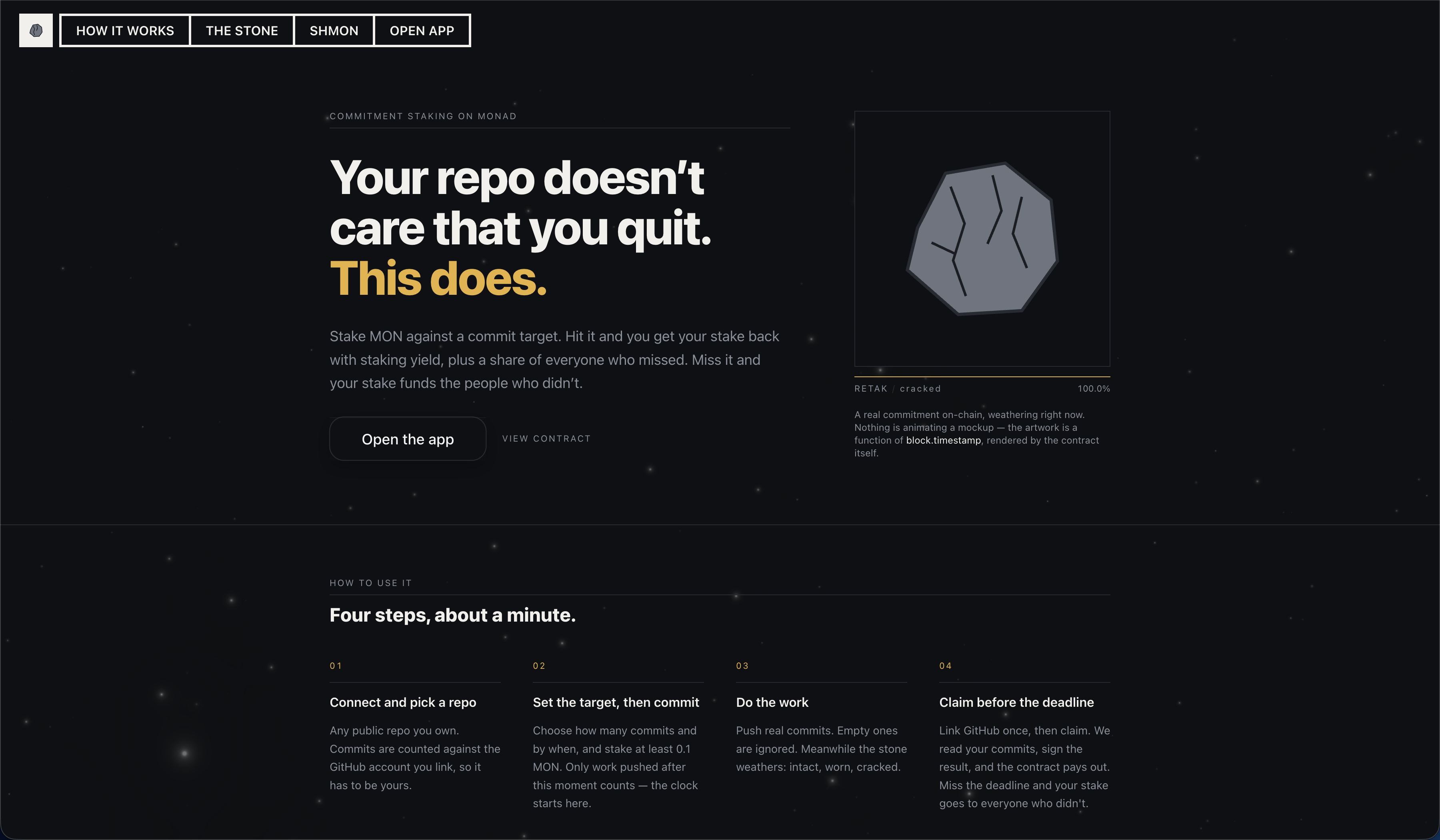
Tamon — commitment staking for developers who keep abandoning their own repos. You name a public repo you own, a commit target, and a deadline, then stake MON behind it. The stake goes straight into shMON — FastLane's liquid staking vault on Monad — in the same transaction, so it earns for the whole period instead of sitting in escrow. Completion is read from the GitHub API: commits with real diffs, by your linked account, pushed after the commitment exists. Empty commits are rejected. Hit the target and you withdraw principal, the yield it earned, and a share of the stakes forfeited while your own capital was at risk. Miss it and yours flows the same way. Every commitment mints a soulbound ERC-721 whose artwork is rendered entirely on-chain and weathers as the deadline approaches — intact, worn, cracked, then shattered or crystallised. It changes with no transaction, no metadata server, and no IPFS: the image is a pure function of block.timestamp, so re-reading tokenURI a minute later returns a different picture. One contract, 17,170 bytes, 54 tests. 67 more on the frontend. Live on Monad testnet at 0x770d9f4f7D667c6663BC74b7b639b923449DaB6b. What problem does it solve I have eleven repositories with a first commit and nothing after it. None failed because the idea was bad or because I couldn't write the code. They failed quietly on a Tuesday, when I decided I'd pick it back up tomorrow — and nothing anywhere registered that I hadn't. Intent is abundant. Consequence is scarce. A to-do app never fixed this, because ticking a box costs nothing and skipping it costs exactly as much. Commitment contracts get closer, but two things bothered me. The money you stake sits idle the entire time. And completion is usually self-reported — the weakest possible check at the exact moment you're most motivated to lie to yourself. The third problem is the one I actually built for: existing systems only speak at the deadline, which is too late to act on. The stone is the fi
讨论
还没有评论,快来分享你的看法吧。