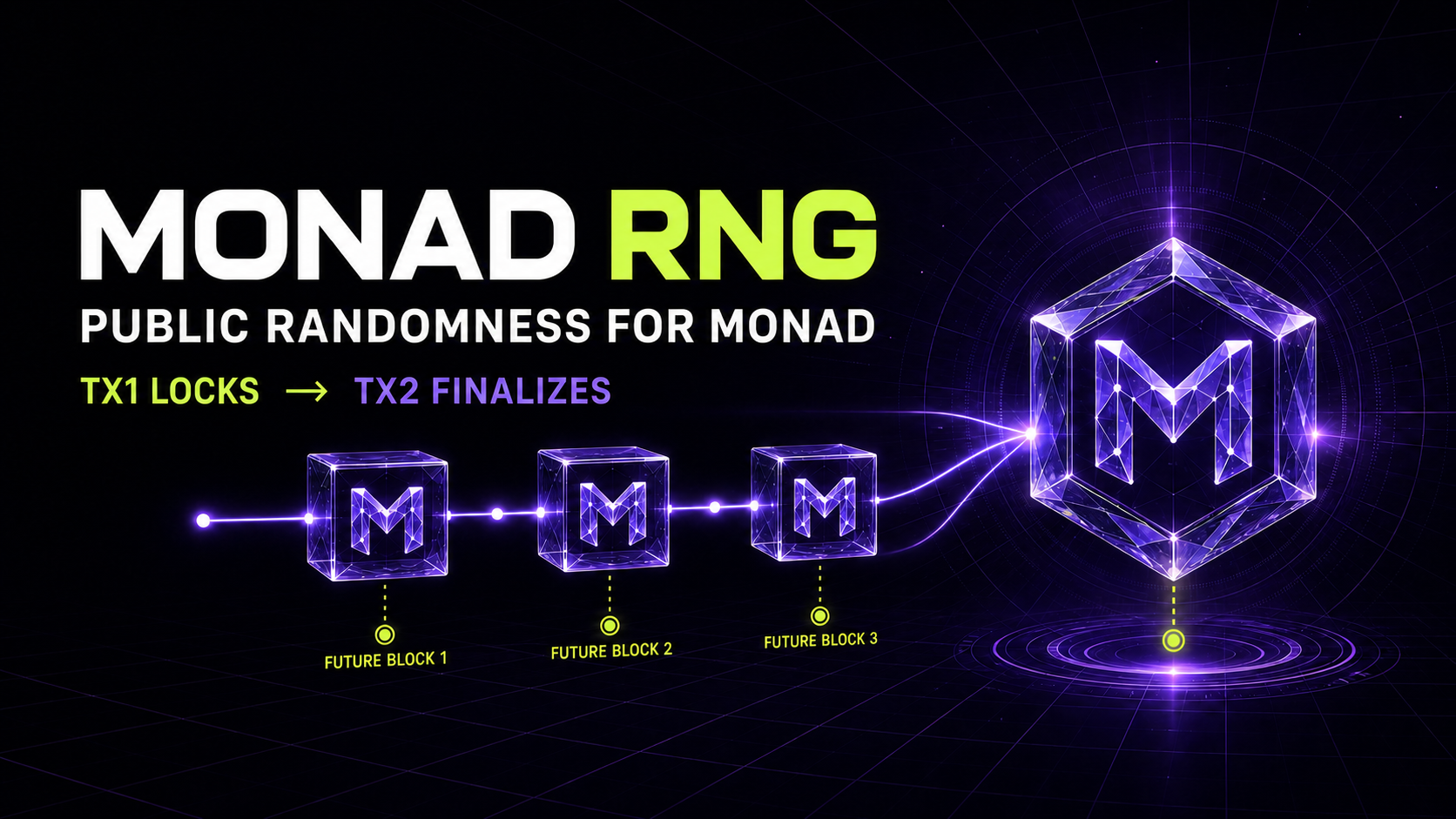
We built Monad RNG, an open-source randomness primitive for Monad applications. It runs without a project-owned backend or centralized oracle. Tx1 locks the requester, payment, and three future block targets. Once those blocks exist, Tx2 submits and verifies their authenticated headers, combines their proposer entropy, and permanently stores the result onchain. The requester gets the first chance to finalize; after a safety delay, anyone can complete Tx2, reducing the risk of a user abandoning an unfavorable result. This solves a common problem for games, raffles, rewards, and gacha systems: they need randomness that users can inspect and applications can consume without trusting one operator. Each platform deploys its own isolated contract, chooses its own request price, and keeps its revenue. Monad RNG charges no protocol fee, although users or operators still pay normal network gas. This design becomes practical at application scale because of Monad’s speed. MonadBFT provides roughly 400 ms block times and about 800 ms deterministic finality, while Monad supports up to 10,000 TPS. Fast consensus makes the wait for future blocks and Tx2 short, and high throughput allows many platforms to request and finalize randomness independently without a global queue. These features do not create randomness by themselves; they make this onchain workflow fast, scalable, and affordable. We learned that a useful randomness system needs more than a hash formula. It also needs permissionless recovery, permanent storage, clear Tx1-to-Tx2 operations, request limits, and honest security boundaries. Monad RNG is not a cryptographic VRF: block producers can still influence block-derived entropy, so applications should set value limits and use stronger randomness for very high-value outcomes.
讨论
还没有评论,快来分享你的看法吧。