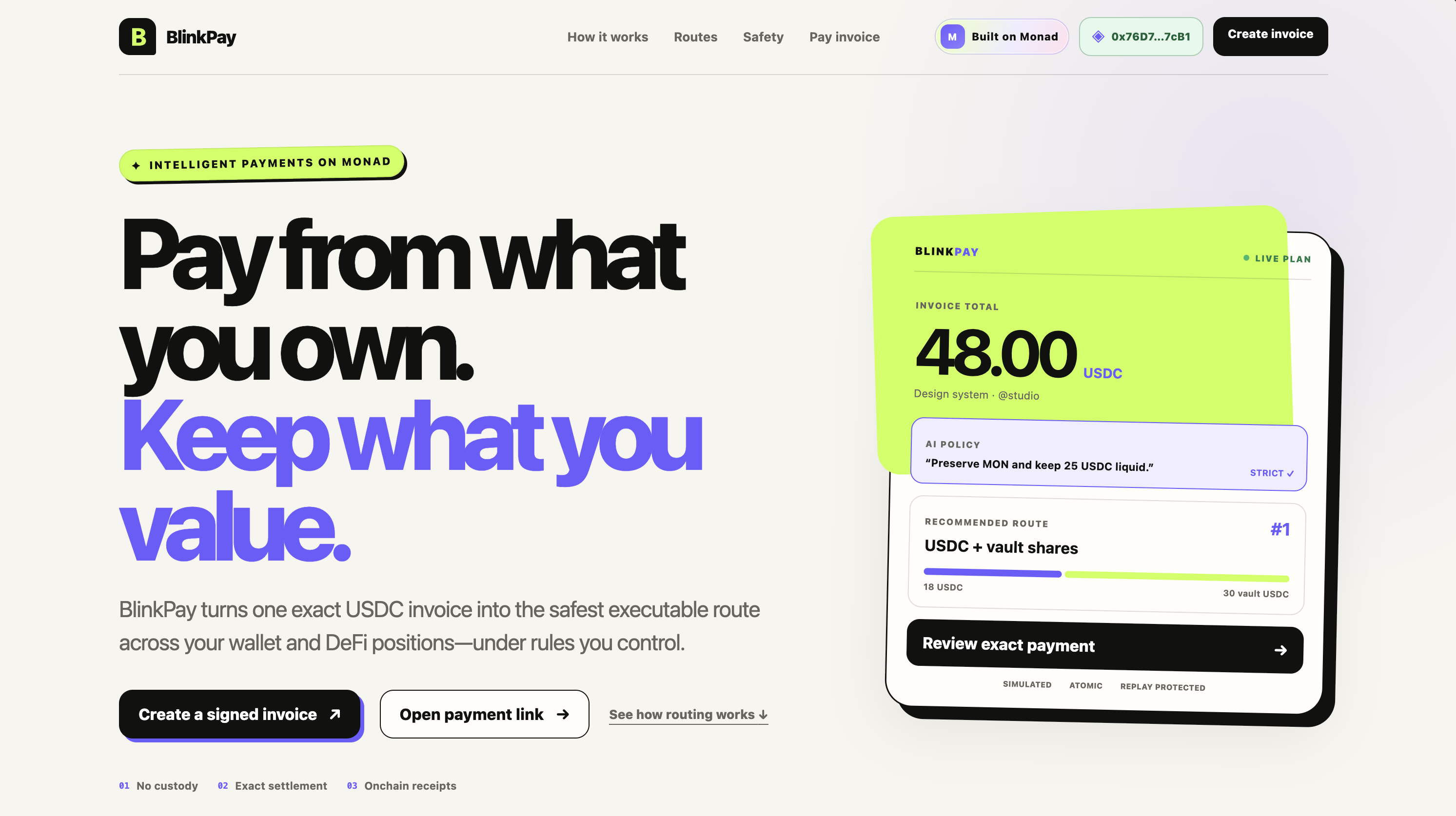
BlinkPay is an AI-assisted, self-custodial payment router built on Monad. A merchant creates an EIP-712 signed invoice requesting an exact amount of USDC and shares it through a payment link or QR code. The payer may hold value across wallet USDC, WMON and ERC-4626 vault shares instead of having enough USDC immediately available. BlinkPay reads live Monad state and evaluates five payment routes: direct USDC, exact-output WMON, exact vault redemption, wallet USDC plus vault, and wallet USDC plus WMON. The payer can describe preferences such as “preserve WMON, use wallet USDC first and never borrow.” AI translates this language into a strictly validated policy, but never receives calldata, custody or signing authority. Deterministic code then checks constraints, simulates and ranks the executable routes. The payer reviews the plan and personally approves it in their wallet. The router enforces the exact merchant balance increase, protected spending caps, atomic execution, zero newly retained payment funds and invoice replay protection. A real Monad Testnet transaction demonstrates a 1 USDC invoice paid atomically using 0.80 wallet USDC plus 0.20 USDC redeemed from a vault. I learned that AI is most useful for translating human intent, while financial execution should remain deterministic and verifiable. I also learned that showing why routes were rejected makes an automated payment planner substantially easier to trust.
讨论
还没有评论,快来分享你的看法吧。