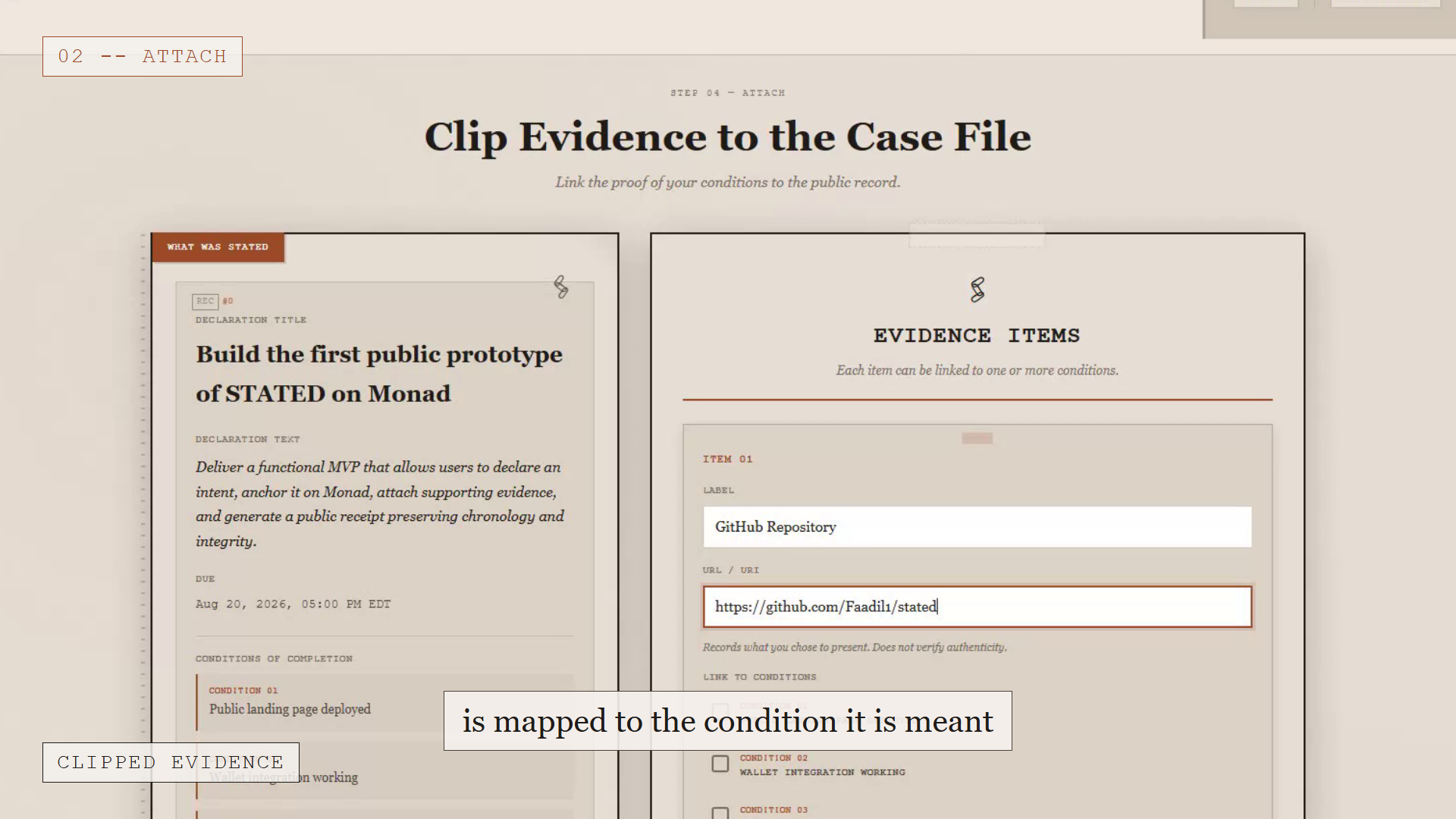
STATED is a public intent registry built on Monad. Before starting a project, a builder records what they intend to deliver, the conditions they are committing to, and a deadline. That declaration is anchored so it cannot be quietly rewritten after the work begins. When the work is ready, the builder attaches evidence such as a live product, source repository, transaction, deployment, or supporting artifact. STATED then generates a public receipt that places two things side by side: • what was stated • what was shown The problem is not that builders never make commitments. The problem is that those commitments are usually scattered across posts, chats, documents, and private notes. Once the project changes, the original promise becomes difficult to recover, compare, or audit. STATED preserves that chronology. It does not decide whether someone completed the work, whether the evidence is authentic, or whether the result is good. It proves the integrity and ordering of the declaration and the evidence attached afterward. For this submission, I used STATED to document the development of STATED itself: declaring the intended MVP, anchoring the record, attaching the live application and repository as evidence, and generating the resulting public receipt. What I learned: • Product trust depends on clear boundaries, not exaggerated claims. • Blockchain is most useful here as an integrity and chronology layer, not as decoration. • Evidence becomes more meaningful when compared against a declaration made before the outcome was known. • A public receipt is easier to understand than a generic activity log or project dashboard. STATED proves chronology and integrity, not completion, quality, authenticity, or truth.
Discussion
No comments yet. Be the first to share what you think.