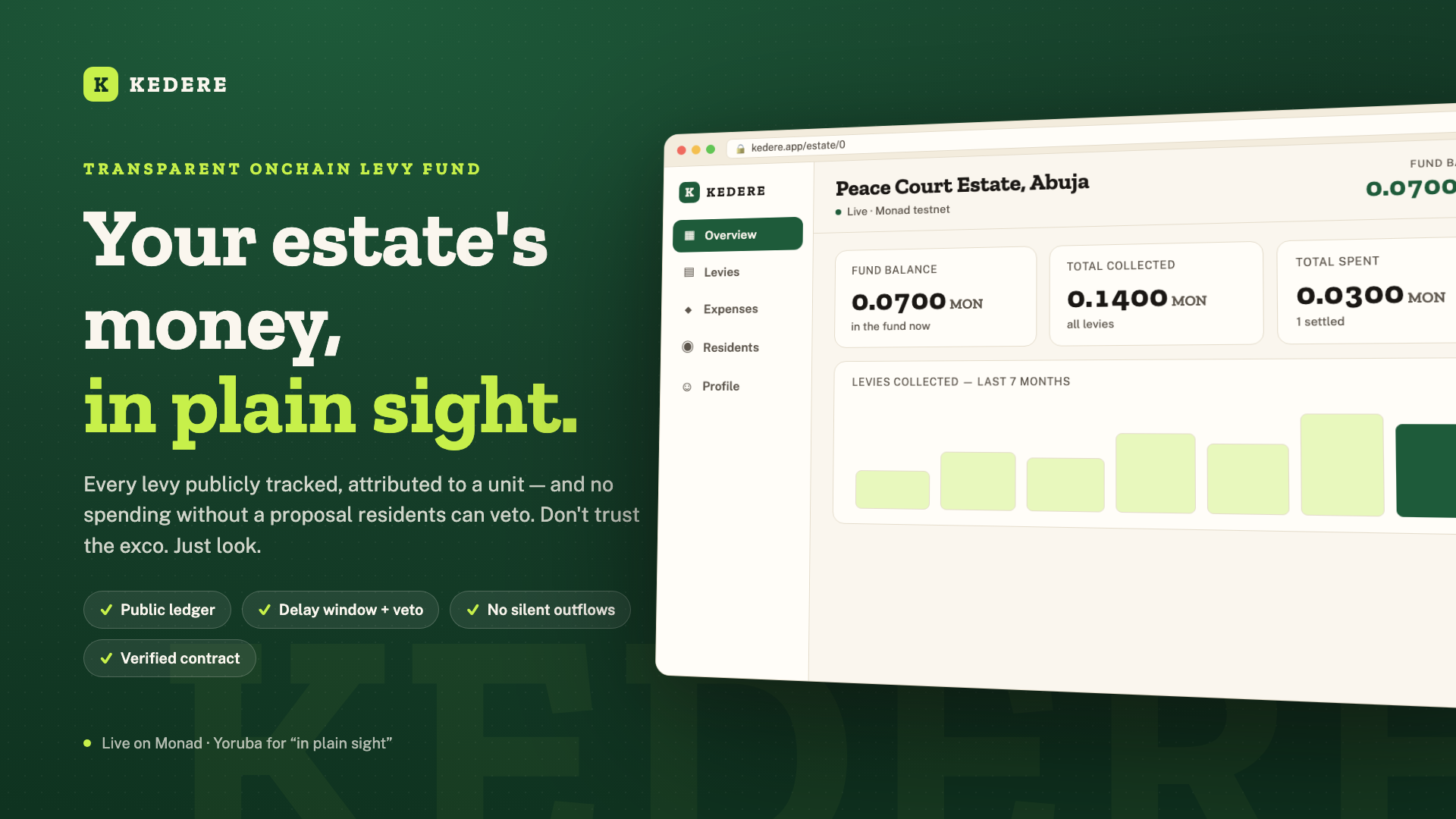
Kedere is a smart contract app that puts residential estate levy funds on-chain, built to fix a real accountability gap. The personal problem: my estate in Abuja collects a monthly levy for diesel, security, water, and repairs, but the money sits in one exco member's personal bank account. Records are WhatsApp photos of receipts, and the "audit" is whoever argues loudest at the AGM. Nobody's necessarily stealing, the issue is nobody can independently verify anything, so trust runs out fast every year. This pattern spans Nigeria. Nairametrics has called residential estates "the new LGAs," mini-governments collecting levies with none of the accountability infrastructure of real government. At Lagos's 1004 Estate, a resident accused management of squandering over ₦5 billion in service charges over five years, management denied it, and with no verifiable ledger neither side could prove their case. At Atlantis Estate, an audit alleged mismanagement, and the manager responded by claiming to legally own the service charge outright, with no obligation to account for it. Kedere, "in plain sight" in Yoruba, moves the fund itself on-chain instead of into anyone's personal account. Every levy payment becomes a public record tied to a specific unit. Spending requires the chairman to post an on-chain proposal with a plain memo, which sits in a public delay window before it executes, giving residents time to object. Enough objections auto-cancel it. Direct transfers revert, so money can only leave through an approved proposal. The contract itself is public and verified, so anyone can check it and nobody can rewrite history. It's built on Monad because the model only works if using it is basically free and instant: standard Solidity and EVM tooling with no exotic stack, sub-cent fees suited to small frequent payments, and about 1 second finality so paying feels like a bank app. Built and deployed on Monad testnet for the hackathon.
Discussion
No comments yet. Be the first to share what you think.